If your cat is peeing everywhere, treat it as a change worth a veterinary conversation first—especially if it is sudden, painful-looking, bloody, or produces little urine. Once urgent medical problems have been considered, record what you see and calmly audit litter-box access, cleaning, household change, and possible marking. More than one factor can be present at once.
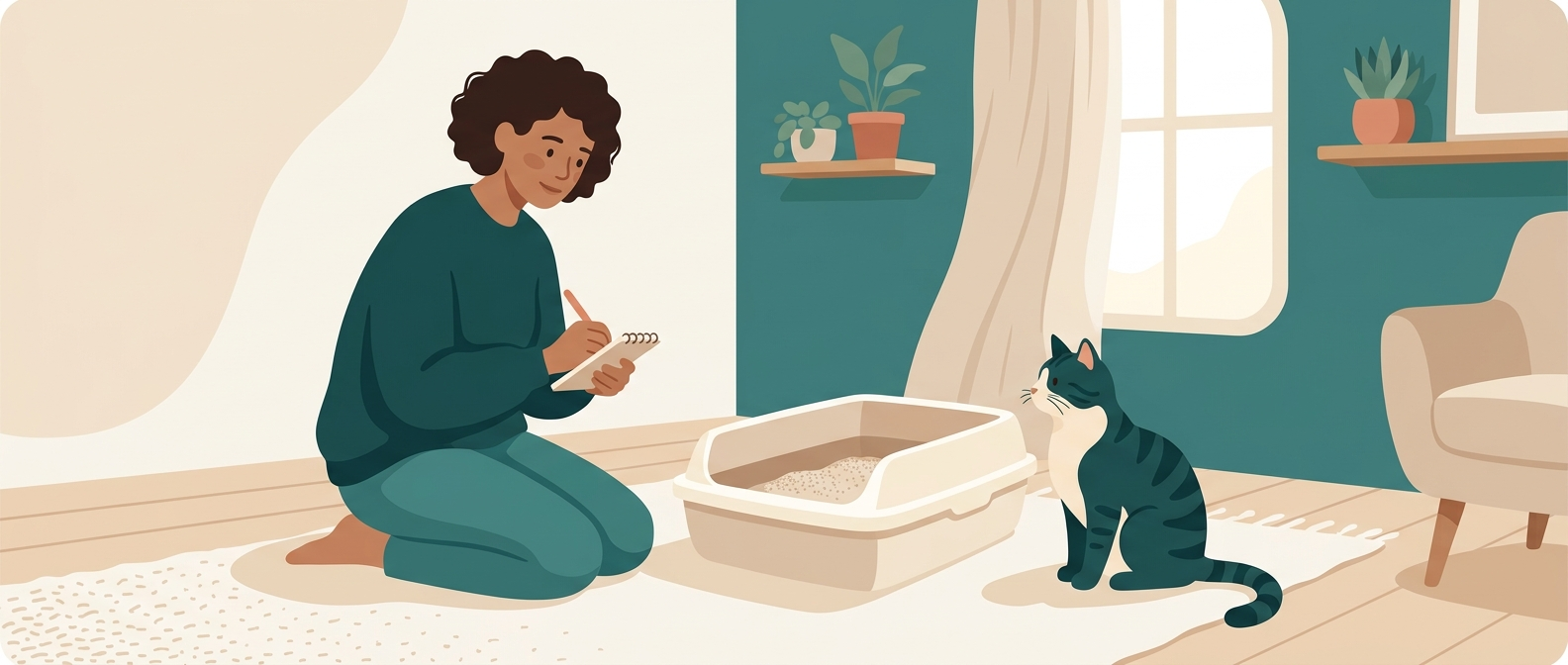
Pico’s first accident was frightening. It was easy to look at the wet spot and jump straight to questions about the litter box, stress, or something we had done wrong. What Pico’s longer journey taught us was simpler and more useful: start by ruling out urgency, write down what you can actually observe, and change the home slowly instead of blaming the cat.
Vet first: when to call now
Seek urgent veterinary help now if your cat is straining or repeatedly trying to urinate with little or no urine, crying or looking painful while trying, has blood in the urine, seems weak or very unwell, vomits, or suddenly cannot pass urine. A urinary blockage can be life-threatening, particularly in male cats. Do not wait to see whether a new litter, cleaner, or calming product changes it. Cornell’s feline lower urinary tract disease guide identifies suspected obstruction as a medical emergency; AAHA advises a thorough veterinary exam as the first step for house soiling.
For a new change without those emergency signs, contact your veterinarian promptly for advice and an appointment. This page can help you prepare observations; it cannot tell you the cause.
Does your cat need urgent veterinary care right now?
Use this as a routing tool, not a diagnosis tool.
START: Your cat is urinating outside the litter box.
|
|-- Is it sudden AND is your cat straining, producing little/no urine,
|   showing blood, crying/pain, vomiting, weak, or very unwell?
|      |-- YES → Urgent veterinary care now.
|      `-- NO  → Contact your veterinarian promptly; keep observing.
|
|-- Is urine often left on a vertical surface, with a standing cat,
|   tail held up or quivering, especially after a new cat or other change?
|      |-- YES → Marking may be part of the picture. Still arrange the vet check,
|      |         then assess territory and household stressors.
|      `-- NO  → Continue.
|
`-- Does your cat squat and leave a puddle, or has box use/location/litter/access changed?
       |-- YES → A litter-box and home audit may help alongside veterinary guidance.
       `-- NO  → Keep a diary and discuss the pattern with the veterinarian.
This tree deliberately overlaps. A cat can have a medical issue and dislike a box, or have marking behavior and a box-access problem. The AAFP/ISFM house-soiling guidelines recommend a systematic, chronological assessment rather than assuming a single reason.
Is it spraying or peeing outside the litter box?
The pattern can give your veterinarian useful context, but it cannot confirm a cause at home.
| What you observe | A possible interpretation to discuss | What to write down |
|---|---|---|
| Cat stands near a vertical surface; small amount of urine; tail may quiver | Urine marking may be involved, particularly around territory or social change | Surface, posture, amount, time, nearby doors/windows, new people or animals |
| Cat squats; a puddle is left on a horizontal surface | Litter-box avoidance, discomfort, or another urinary/behavioral factor may be involved | Puddle size, place, box condition, litter, and whether this is new |
| Repeated trips, straining, little urine, pain signs, or blood | A potentially urgent urinary problem | Exact time, attempts, amount, other signs; seek urgent veterinary care |
In plain language: vertical, small-volume deposits can fit marking; squatting and puddles can fit toileting outside the box. Neither observation proves why it happened. Sudden change, pain signs, blood, or little/no urine take priority over pattern-reading. Cornell notes that medical and behavioral contributors both need consideration.
What should you record before the vet visit?
Bring a short, factual timeline. It is more useful than trying to decide whether your cat is being “difficult.”
- When did the first accident happen, and was the change sudden or gradual?
- How often has it happened, and at what times?
- Did your cat squat or stand? Was the surface horizontal or vertical?
- Was the amount a puddle, drops, or unclear?
- Were there any signs of straining, vocalizing, blood, licking, hiding, vomiting, reduced appetite, or low energy?
- Which litter boxes were available: where, how clean, open or covered, and easy or difficult to reach?
- What changed recently: a move, visitors, renovation, schedule shift, new pet, conflict, new litter, new box, or a changed cleaning product?
- In a multi-cat home, could another cat have watched, blocked, or ambushed access to a box?
Take a photo of the location only if it helps explain the pattern; there is no need to disturb or film a cat who looks uncomfortable. Our forthcoming guide, Is it spraying or peeing? The photo-free clues to record for your vet, turns these notes into a one-page log.
Has something changed around the litter box?
Once you have spoken with a veterinarian about a new or ongoing problem—and after emergency signs have been ruled out—make the home easier to use. Do not make every change at once; otherwise you will not know what your cat tolerated or avoided.
A calm litter-box audit
- Access: Can your cat reach a box without passing a dog, a noisy appliance, a closed door, or another cat?
- Choice: In a multi-cat household, are boxes spread out so one route cannot be guarded? The usual starting point is one box per cat plus one extra, adjusted to your home and cats.
- Location: Is there a quiet, predictable route and an exit route rather than a trapped corner?
- Size and entry: Can your cat turn around comfortably? Is the entry manageable for their current mobility?
- Cleanliness: Are solids and clumps removed regularly, and is the box cleaned without heavily scented products?
- Litter: Has scent, texture, depth, or brand changed recently? Many adult cats may prefer plain, unscented, clumping litter, but individual preference varies. Treat it as a starting point to test, not a rule. AAHA/AAFP
- Box design: Do not assume covered, open, top-entry, or automatic is universally best. A cat’s access, room layout, and individual response matter.
For a deeper, one-variable-at-a-time setup trial, see the cat-first litter-box setup pillar and covered vs. open litter-box home trial.
Could stress or territory be part of the picture?
Possibly—but “stress” is not a diagnosis and should not become a reason to skip the vet. Household change, conflict between cats, unfamiliar animals visible through a window, and disruption to predictable routines can all be relevant context. AAHA lists medical, environmental, stress-related, and territorial factors among reasons a cat may stop using the litter box. AAHA
Try this low-drama reset while you gather observations and follow veterinary advice:
- Keep feeding, play, and quiet time predictable for a few days.
- Give each cat separate routes to essentials: resting places, water, food, scratching areas, and litter boxes.
- Add a quiet resting spot with cover and height where practical; do not force your cat to use it.
- Block visual triggers only if you can identify one, such as an outdoor cat repeatedly appearing at a particular window.
- Avoid punishment, yelling, or carrying a cat to the box after an accident. These responses can add fear and do not explain the underlying problem. AAHA/AAFP
Pico’s experience is why we favor a calm sequence over a frantic shopping list. We learned to note what had changed, make one practical adjustment, and take the notes to the vet. That is one household’s story—not proof that the same adjustment will solve another cat’s problem.
What should you avoid doing today?
- Do not assume it is spite, revenge, or “bad behavior.”
- Do not delay urgent care for straining, very little/no urine, blood, pain, or a cat who seems seriously unwell.
- Do not punish your cat or rub their nose in urine.
- Do not suddenly replace every box, litter, room routine, and cleaning method at the same time.
- Do not use strong-smelling cleaners around a box. For soiled areas, use a cat-safe cleaner as directed and follow your veterinarian’s cleaning guidance where relevant.
- Do not expect pheromone products, supplements, a new box, or a new litter to diagnose or fix urinary disease. These may be discussed as supportive environmental tools only after the health assessment and alongside a wider plan.
If the accident was on bedding, start with Cat peeing on the bed: the first 24 hours and mistakes to avoid. For the non-medical cleaning and repeat-target sequence, use the cat spraying and urine-odor pillar.
What does a seven-day calm reset look like?
This is a modest observation plan, not a deadline for recovery. Stop and seek veterinary advice sooner if symptoms worsen or new red flags appear.
| Day | Focus | Write down |
|---|---|---|
| 1 | Vet contact and safety check | Symptoms, urgency advice, first timeline |
| 2 | Make all boxes easy to reach | Routes, obstacles, box locations |
| 3 | Clean and stabilize | Cleaning routine, litter/box details; no wholesale switches |
| 4 | Watch social traffic | Staring, blocking, chasing, outdoor-cat triggers |
| 5 | Add calm choice | Resting spot, separate resource, predictable routine |
| 6 | Change one small variable only if appropriate | Exactly what changed and your cat’s response |
| 7 | Review with the diary | Accidents, box use, patterns, questions for the vet |
Summary: first make sure your cat is safe; then reduce access problems and household pressure while recording patterns. The goal is not to force a quick explanation—it is to give your veterinarian and household a clearer next step. Use the observations to record before a vet visit as a practical diary prompt.
Frequently asked questions
Why is my cat suddenly peeing everywhere?
A sudden change needs veterinary attention because urinary discomfort or illness can be involved, alongside environmental, stress-related, territorial, or litter-box factors. Record the timing and any pain or urine changes; seek urgent care for straining, little/no urine, blood, or serious illness signs. AAHA
Is my cat spraying or peeing?
Standing with a small amount of urine on a vertical surface can be consistent with marking, while squatting and a puddle on a horizontal surface can be consistent with toileting outside the box. They are clues, not diagnoses, and a cat can have overlapping contributors. Share the pattern with your veterinarian.
Can stress make a cat pee outside the litter box?
Stressful changes or territory-related tension can be relevant, but it is not safe to assume stress is the sole cause. Arrange veterinary assessment for a new or persistent change, then review litter-box access, resources, routines, and household triggers. AAFP/ISFM house-soiling guidelines
How many litter boxes should I have?
A common starting point for a multi-cat home is one box per cat plus one extra, located so cats do not have to pass through a bottleneck or another cat to use one. Your veterinarian or feline behavior professional can help tailor this to mobility, space, and household relationships.
Should I change litter immediately?
If a litter change coincided with the problem, record it and discuss the overall situation with your veterinarian. Avoid making many sudden changes at once. When a change is appropriate, trial one variable at a time and keep a diary so you can see whether access, scent, texture, or another factor matters.