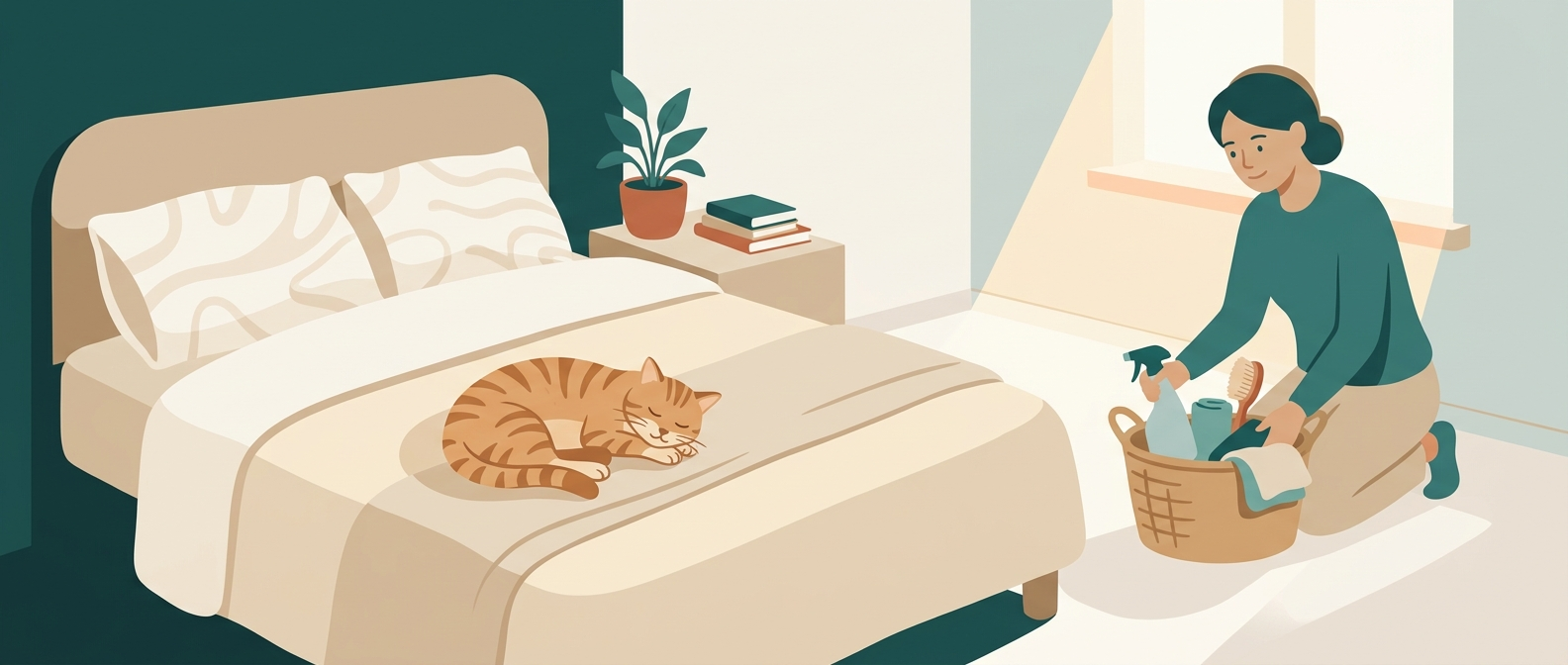
When a cat pees on the bed, start with safety—not a cleaning product or a theory about why. A sudden or persistent change in urination needs veterinary advice because discomfort or illness can be involved. Check for urgent signs, protect the bedding and mattress, record what happened, and clean the area without punishing your cat or making a dozen home changes at once.
The bed is upsetting because it is personal, absorbent, and hard to keep off-limits. It is also useful information: note the exact surface, timing, amount, posture if you saw it, and anything that changed around the home. A bed accident does not tell us one cause by itself. Medical, environmental, and social contributors can overlap. AAFP/ISFM house-soiling guideline
Urgent: contact a veterinarian now
If your cat is repeatedly straining to urinate, producing little or no urine, crying out, showing blood in the urine, vomiting, becoming weak or collapsed, or seems in severe pain, contact a veterinarian or emergency clinic now. A blocked urinary tract can be life-threatening. Do not wait for a litter change, cleaner, diffuser, or home remedy to work. If you are unsure, call your local veterinary service and describe exactly what you are seeing. Cornell’s feline lower urinary tract disease guide
What should you do in the first 24 hours after a bed accident?
First, check your cat rather than the stain. If there are no emergency signs, contact your veterinarian promptly about a new or persistent urination change. Then make the bed temporarily inaccessible if practical, remove wet bedding, and begin a short fact-only log. AAHA advises that a thorough veterinary examination is the first step when a cat stops using the litter box. AAHA
First-24-hours checklist
- Check for urgent signs. Straining, repeated attempts with little or no urine, blood, pain, vomiting, weakness, collapse, or severe illness mean urgent veterinary contact now.
- Call your veterinarian promptly for a sudden or ongoing change, even if your cat otherwise seems comfortable.
- Record the event before cleaning. Write the time window, room, surface, amount, posture if observed, litter-box access, and recent household changes.
- Remove and rinse bedding with cool water where the care label permits. Keep the cat away from the wet area while you work.
- Blot the mattress; do not scrub it. Press clean towels into the wet area to lift moisture. Follow the cleaner and mattress labels exactly; test any product on an inconspicuous area first.
- Keep the litter-box setup stable and reachable. Scoop as usual and make sure routes are open. Do not replace every box or litter overnight unless your veterinarian tells you to.
- Reduce repeat access without drama. Close the bedroom door temporarily, use a washable waterproof layer once the bed is dry, or offer an alternative resting place. Do not carry or force your cat into a box.
When is cat peeing on the bed an emergency?
The surface does not determine urgency; your cat’s urinary signs do. Repeated straining, very small or absent urine output, blood, crying, vomiting, weakness, collapse, or severe pain need urgent veterinary care. A cat that suddenly starts urinating outside the box without those signs still needs prompt veterinary advice. Cornell and AAHA both stress that medical and non-medical contributors need consideration.
What should you record before you clean the bed?
Write only what you know. This makes the vet conversation more useful than guessing at motivation.
| Record | Useful detail | Why it helps the next conversation |
|---|---|---|
| Timing | Exact time, or a window such as “between 8 and 10 a.m.” | Connects the event with routines, access, or changes without assuming a cause |
| Pattern | Standing, squatting, not seen; drops, patch, puddle, or unknown | Gives the veterinarian observable context |
| Bed and room | Duvet, sheet, mattress, laundry on bed; bedroom door open or closed | Identifies the exact surface and any access pattern |
| Urinary signs | Straining, repeated trips, blood, vocalising, licking, vomiting, or none seen | Flags information that may change urgency |
| Litter-box context | Number, locations, access, cleaning, litter/box changes | Helps review practical barriers alongside medical assessment |
| Recent changes | Visitors, move, schedule shift, new pet, outdoor-cat activity, renovation | Adds context; it does not prove stress is the cause |
Plain-text summary: the most useful notes are when it happened, what you actually saw, how much urine there was, where it landed, any illness signs, box access, and recent changes. A bed accident can occur alongside more than one contributor, so do not use the location as a diagnosis. For posture and surface clues, see Is it spraying or peeing? The photo-free clues to record for your vet.
How can you clean cat urine from bedding and a mattress safely?
Cleaning is for hygiene and comfort; it does not answer why the accident happened or make a veterinary check unnecessary. Remove washable layers promptly, use the care labels for the bedding and mattress, and let the mattress dry fully before remaking the bed. Avoid mixing cleaning products or using strong fragrances around your cat.
| Surface | Immediate step | What to avoid | Next boundary |
|---|---|---|---|
| Sheets, duvet cover, washable protector | Separate, rinse cool where the label allows, then wash as directed | Heat-setting a stain before the label-safe wash; heavily perfumed additions | Rewash only as the fabric-care instructions allow |
| Mattress or foam topper | Blot with towels; use a product only according to its label and the mattress maker’s instructions; allow full drying | Saturating the foam, scrubbing, or mixing cleaners | If urine reached deep layers or odour remains, follow the manufacturer’s care route or seek a professional cleaning opinion |
| Pillows or non-washable bedding | Check the item’s care label and isolate it from the cat while wet | Assuming every pillow can be machine-washed | Replace or seek specialist cleaning only according to the product’s care guidance |
Plain-text summary: washable bedding and a mattress need different care. Rinse and wash removable layers according to their labels; blot rather than soak a mattress, and allow it to dry fully. Never combine cleaners, and do not assume cleaning answers a behavioural or medical question.
For the broader non-medical cleaning sequence after urgent-care and vet-first steps, use the cat spraying and urine-odor pillar. It keeps odor cleanup separate from guessing at a diagnosis.
Why might a cat choose a bed?
We cannot know from the bed alone. A cat may return to a familiar soft surface, have trouble reaching or accepting a litter box, react to a home or social change, or have discomfort that needs medical assessment. Cornell notes that house-soiling can have medical, litter-box, and behavioural contributors, and that one issue can lead to another. Cornell: House Soiling
After veterinary advice, look for practical observations rather than a single explanation: Was the bedroom suddenly closed? Has the litter, box, route, or cleaning routine changed? Could another cat watch or block the route? Is an outdoor animal repeatedly visible from a nearby window? These are questions to bring to a calm home review, not evidence that your cat is doing this deliberately.
Which mistakes can make the next day harder?
- Do not punish, shout, or rub your cat’s nose in urine. Punishment can add fear and does not identify the reason for the accident. Cornell
- Do not wait out red flags to see whether a cleaner, new litter, or calming product changes them.
- Do not assume a bed accident is “stress” or marking. A sudden change needs veterinary input first.
- Do not change everything at once. New litter, boxes, cleaners, room access, and routines all on one day leave you with no clear record of what your cat tolerated.
- Do not trap your cat away from essentials. If you close the bedroom, check that litter, water, resting spots, and routes remain accessible.
- Do not use fragrance to cover the smell. Follow product labels and keep the cleaning process simple and well ventilated.
What can you change after the vet conversation?
Once urgent problems have been ruled out and your veterinarian has advised on the next step, choose one modest change that improves access or predictability. This might mean reopening an easy route to a box, adding a box in a separate location for a multi-cat home, or keeping the bedroom closed temporarily while offering another comfortable resting place. Do not assume a covered or open design is universally right; use a fair, one-variable trial. Covered vs open litter boxes: evidence plus a fair home trial explains how to do that without turning the house into an experiment.
For the wider sequence—safety, observations, litter-box access, and home context—go back to My cat is peeing everywhere: a vet-first decision tree. Its observation checklist can keep the follow-up conversation focused.
Pico’s log: what we can and cannot say about the first accident
Pico’s house-soiling journey is why we do not want a single wet bed to become a verdict. Our household learned to record the location, keep the response calm, and separate cleaning from the question of why it happened.
What we know from our record: Pico’s experience involved changes to litter-box setup, litter, pheromone context, and routine over time.
What we do not know: this source record does not contain a verified first-bed-accident date, a complete mattress-cleaning sequence, or a single cause. We will not invent one. For the documented one-variable approach, read Pico’s seven-day litter-box reset.
Pico’s experience is a single household story, not veterinary advice or a guarantee for another cat.
What should you do next?
Check your cat for urgent signs, call your veterinarian promptly for a new or ongoing change, clean the bed according to its care labels, and start a short observation log. The goal is not to make the bed perfect before anyone knows what happened. It is to keep your cat safe and give the veterinary conversation useful facts.
Frequently asked questions
Why did my cat pee on my bed?
A bed accident alone cannot identify one reason. Medical discomfort, litter-box access or preference, household or social change, and other contributors can overlap. A sudden or persistent change needs veterinary advice; urgent urinary signs need immediate care. AAFP/ISFM
Should I keep my cat out of the bedroom?
Temporary bedroom closure may protect the bed while you clean and gather observations, provided your cat still has easy access to litter boxes, water, resting places, and safe routes. It is a management step, not a solution or a punishment.
Can I use a pheromone diffuser after my cat pees on the bed?
Ask your veterinarian whether a pheromone product fits the wider plan after the medical assessment. A diffuser cannot replace urgent care, a veterinary work-up, clean accessible litter boxes, or a review of household pressure. See Cat pheromone diffusers: what they can support and what they cannot replace.
How do I remove cat urine from a mattress?
Blot the area, follow the mattress and cleaner labels, avoid soaking foam or mixing products, and allow the mattress to dry fully. Care instructions differ by material, so the label takes priority. Cleaning does not replace veterinary advice for a new or persistent urination change.
Is my cat doing this to get back at me?
No-shame matters here: do not assume revenge or intent. Treat the accident as information to record and discuss with a veterinarian. Punishment can increase fear and does not explain the underlying contributor. Cornell
Sources and publication note
This article draws on AAHA’s litter-box guidance, the AAFP/ISFM house-soiling guideline, Cornell’s house-soiling guidance, and Cornell’s feline lower urinary tract disease guide. Accessed July 19, 2026.
Not veterinary advice: This article provides general educational information and describes one household’s experience. It does not diagnose, treat, or replace advice from a licensed veterinarian. If your cat’s behaviour or health changes, contact your veterinarian; seek urgent care for emergency signs. Product information is not a recommendation for every cat, and your veterinarian should advise on medicines, supplements, and medical conditions. Pico’s experience is not evidence that the same approach will work for another cat.
CTA: Copy the first-24-hours checklist and bring your event log to your cat’s veterinary appointment.