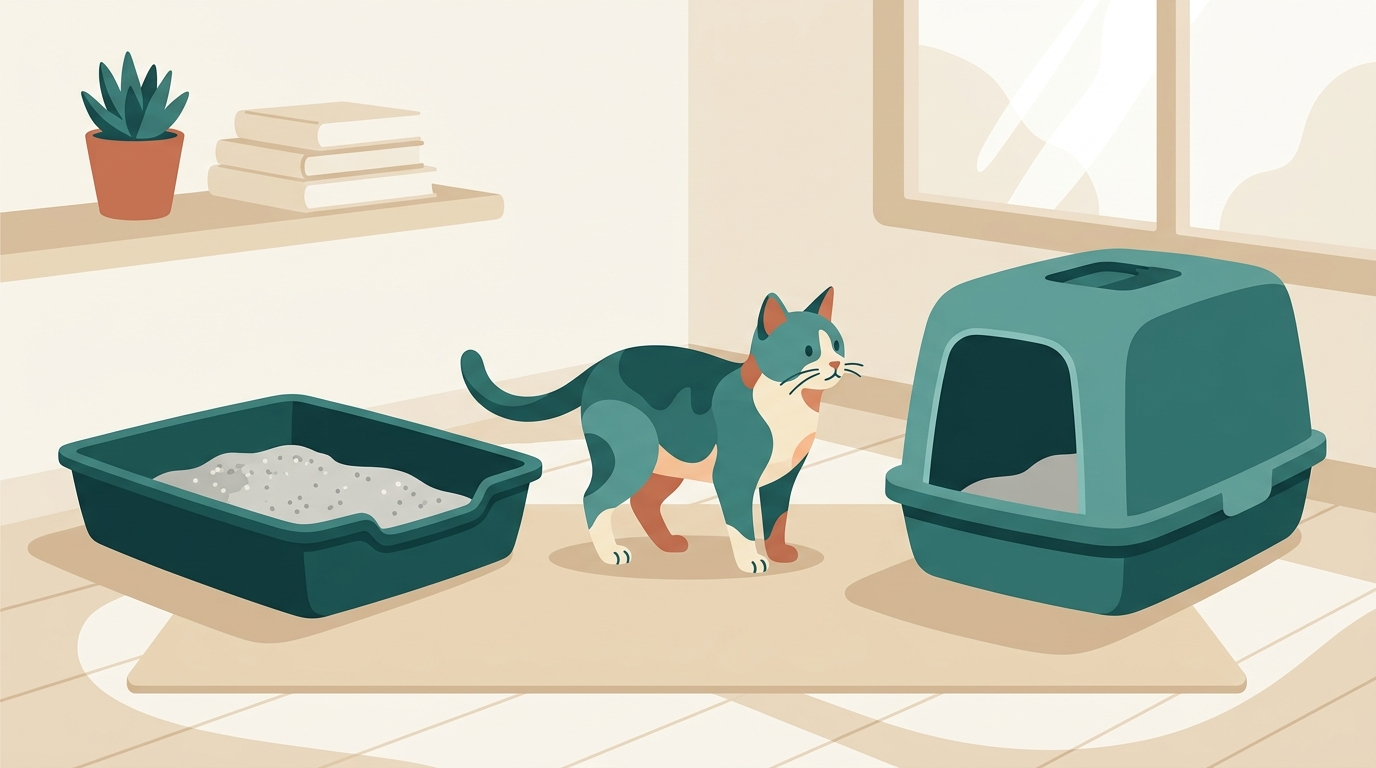
Short answer: neither a covered nor an open litter box is the universal winner. In a small 14-day study of 27 cats, most showed no clear preference when the boxes were otherwise matched and cleaned daily; a minority preferred one style or the other. If your cat is well enough for a home setup trial, offer a fair choice and change one variable at a time.
If your cat has suddenly stopped using the box, do not treat this as a shopping decision first. Urinary discomfort, illness, stress, access, litter, location, and social pressure can overlap. AAHA advises a veterinary examination as the first step for house-soiling. Start with our vet-first guide to a cat peeing everywhere if this is a new or persistent change.
Urgent: contact a veterinarian now
If your cat is repeatedly straining to urinate, producing little or no urine, crying out, showing blood in the urine, vomiting, becoming weak or collapsed, or seems in severe pain, contact a veterinarian or emergency clinic now. A blocked urinary tract can be life-threatening. Do not wait for a litter-box trial, cleaner, diffuser, or home remedy. If you are unsure, call your local veterinary service and describe exactly what you are seeing.
What does the covered-versus-open study actually show?
The often-cited study gave cats a matched covered box and open box for 14 days, with daily scooping. Of 28 enrolled cats, 27 were included in the analysis. There was no significant overall difference in use between the two styles: eight cats showed an individual preference, split four for covered and four for open, while the others did not show a clear preference. Read the study: Litter box preference in domestic cats: covered versus uncovered.
That is useful because it pushes back on an absolute rule such as “all cats hate covered boxes.” It is not a verdict for every home. The cats had no recent elimination disorder, each had exclusive access to two specially matched boxes, other household cats were separated during the test, and the trial lasted 14 days. A cat who is in pain, has mobility limits, feels blocked by another pet, or has a very different box and room setup may face a different question.
AAFP/ISFM guidance similarly frames box type as one part of the full setup, alongside cleaning, substrate, size, location, number of boxes, and access. It notes that individual preferences vary and that keeping boxes clean can matter more than the covered/open distinction. AAFP/ISFM house-soiling guidelines.
How do covered and open litter boxes compare in everyday use?
The practical trade-off is not “privacy versus no privacy.” It is whether the complete setup gives your cat room, a predictable route, and a usable box. A covered box may contain some scatter for the household; an open box may make the interior and surrounding traffic easier to see. Neither feature tells us which one a particular cat will choose.
| Question to compare | Covered box | Open box | What to observe instead of assuming |
|---|---|---|---|
| Can your cat enter, turn, dig, and leave comfortably? | The hood and entrance can reduce usable space in some designs. | The full box footprint is visible, but side height and size still vary. | Watch for hesitation, awkward turning, perching, or leaving quickly. |
| Can your cat approach and leave without feeling cornered? | Usually has one main entrance; room placement matters greatly. | May offer a clearer view of the room, depending on the sides and location. | Watch the route, nearby pets, doors, appliances, and whether another cat waits near the box. |
| How easy is it to notice and remove waste? | Waste may be less visible to people, so a scoop routine needs to be deliberate. | Waste is easy to see, which may make the cleaning check simpler. | Keep the same scoop schedule for both options. |
| What about odor and scatter for people? | May feel tidier to people, but it still needs frequent cleaning. | May allow more litter scatter, depending on the box and litter. | Separate the human housekeeping preference from the cat’s observed use. |
| Is it a good choice for an older or less mobile cat? | A small entrance or high step may be harder for some cats. | A low-entry, open design may be easier to enter, but the exact design matters. | Ask your veterinarian about mobility concerns rather than guessing from age alone. |
Text summary: the table does not declare a winner. Covered boxes can reduce visible mess for people, while open boxes can make cleaning and room visibility simpler. For the cat, usable size, entry height, a clear route, regular cleaning, and individual response are more informative than the label on the box.
When should you pause the box trial and call the vet?
Pause the experiment and contact your veterinarian if a new or ongoing change in toileting is not already being assessed. Seek urgent help for the signs in the box above. A home comparison cannot tell you whether a cat is uncomfortable or why they are avoiding a box.
Once a veterinarian has advised that a setup trial is appropriate, keep the goal modest: learn what your cat approaches and uses under matched conditions. Do not use a trial to delay follow-up, and do not punish accidents. AAHA lists medical issues, stress, box setup, and territorial behavior among possible contributors to house-soiling. AAHA: Why Won’t My Cat Use the Litter Box?.
How can you set up a fair covered-versus-open home trial?
The study’s strongest practical idea is the comparison, not a magic box style. Try to make the two choices as alike as your home allows. If the only covered box you own is much smaller than the open box, you are testing size and cover together—not just the cover.
Step 1: set a steady baseline before changing anything
For a few days, record the current box setup: box dimensions, entry height, litter type and depth, location, cleaning times, other pets nearby, and what you observe. Note facts rather than conclusions: “paused at doorway,” “used box at 7 pm,” or “dog passed hallway,” not “felt anxious.”
If you have multiple cats, make sure there are enough boxes and that they are spread out rather than lined up as one guardable station. AAHA’s common starting point is one box per cat plus one extra, in quiet locations with accessible routes. AAHA guidance.
Step 2: match the two boxes as closely as possible
Use the same litter, similar litter depth, and the same cleaning schedule. Choose boxes with similar internal floor space where possible. Put them in the same general quiet area only if that does not create a bottleneck; side by side can make the style comparison cleaner, but it may not be the best long-term layout for a multi-cat home.
Do not add a new litter, scented cleaner, diffuser, automatic box, or different location on the same day. Those may be reasonable questions later, but they make this trial hard to read.
Step 3: change one variable—the cover—and offer both choices
Provide one covered and one open box at the same time. Keep the entrances accessible and do not place either box beside food, water, a loud appliance, or a route where a pet can block access. Scoop both on the same schedule, ideally before your regular observation check.
If your cat is used to a covered box, do not remove every familiar box abruptly just to make the test neat. Add the alternative choice and keep the change low-pressure. The point is observation, not forcing a preference.
Step 4: record use for a meaningful, calm window
The study ran for 14 days. At home, your veterinarian can help decide what is appropriate for your cat; a short log is still more useful than judging one visit. Record which box was used when you can tell, any hesitation or avoidance you safely observe, cleaning times, accidents, household disruptions, and access problems.
| Date and time | Covered or open? | What you observed | What stayed the same? | Other context |
|---|---|---|---|---|
| e.g., entered and used; paused; unclear | litter, cleaning schedule, location | visitor, appliance noise, another pet nearby |
Text summary: a usable log separates the box style from the rest of the day. If the litter, location, cleaning routine, and household traffic all change too, the result is a diary of disruption—not a fair comparison.
Step 5: decide what the trial can honestly tell you
Look for a repeatable pattern, not a perfect score. A clear, repeated preference can be useful information to keep and share with the veterinary team. Similar use of both boxes is also useful: it suggests you may need to look at a different variable, such as access, size, litter, cleaning, or location.
If a cat avoids both boxes, starts toileting outside the box, or shows any health concern, stop interpreting the spreadsheet and contact the veterinarian. Do not keep switching equipment in search of an answer.
What did Pico’s box trial teach us about changing one variable?
Pico’s log: a bounded household example
In Pico’s seven-day litter-box reset, we removed the hood on day 1 while trying to keep the rest of the setup steady. Pico inspected the open box sooner, but we did not call that a preference after one day. On day 2, we moved that same box, so we could no longer separate box style from location as cleanly. That was our failed attempt: changing variables across consecutive days made the evidence weaker.
Our result was only a clue: the open box and clearer approach route looked more promising in Pico’s home; the role of the cover itself remained uncertain. The useful lesson was procedural—make fewer changes, record what stays the same, and resist naming a winner too early.
Pico’s experience is a single household story, not veterinary advice or a guarantee for another cat.
What should you choose if you can offer only one box today?
If a veterinarian has ruled out urgent concerns and you must make one practical choice, prioritize a box that is roomy for your cat, easy to enter, kept clean, and placed on an accessible route. AAHA describes shallow, uncovered boxes at least one-and-a-half times a cat’s nose-to-tail length as a general preference, while also recognizing that individual cats can differ. AAHA guidance.
That is a starting point, not a promise. A cat who already uses a suitable covered box comfortably may not need a disruptive switch. A cat struggling with a small, hard-to-access covered box may benefit from an additional matched open option—but a veterinary conversation comes before attributing a toileting change to the lid.
For the wider decision, use our cat-first litter-box setup pillar and Pico’s one-variable-at-a-time reset. They help separate box type from litter, cleaning, location, and household traffic.
FAQ
Do cats prefer covered or open litter boxes?
There is no universal answer. In one 14-day study of 27 cats using matched boxes, most did not show a clear preference; four preferred covered and four preferred open. The study was small and did not include cats with recent elimination problems, so use it as a reason to observe your own cat rather than as a rule. Covered versus uncovered study
Are covered litter boxes bad for anxious cats?
Not automatically. A covered box may be fine for one cat and awkward for another. A sudden toileting change needs veterinary advice first; then consider the whole setup, including usable space, entrance, location, cleaning, and whether another pet can block the route.
Should I remove the lid from my cat’s litter box?
Do not make an abrupt all-or-nothing switch if your cat is already using the box comfortably. When a trial is appropriate, add a similar open alternative, keep litter and cleaning the same, and observe one variable at a time. If your cat is toileting outside the box or seems unwell, contact a veterinarian instead of relying on a lid change.
How long should a covered-versus-open litter-box trial last?
The published comparison ran for 14 days, but that is not a universal prescription. Ask your veterinarian what is appropriate for your cat’s situation. Record the setup and observations consistently rather than deciding from a single visit or accident.
Does an open litter box help a cat who is peeing outside the box?
It may be worth discussing as one setup variable after veterinary guidance, but it cannot explain or resolve a medical problem. House-soiling can have overlapping medical, environmental, and social contributors. Keep a record and contact your veterinarian about a new or persistent change.
Sources and editorial note
- Grigg EK, Pick L, Nibblett B. Litter box preference in domestic cats: covered versus uncovered. Journal of Feline Medicine and Surgery (2013). — 27-cat, 14-day matched-box study; use and limitations discussed above.
- AAFP/ISFM Guidelines for Diagnosing and Solving House-Soiling Behavior in Cats — systematic work-up and environmental considerations.
- American Animal Hospital Association: Why Won’t My Cat Use the Litter Box? — veterinary assessment, box setup, cleaning, location, and access guidance.
Not veterinary advice: This article provides general educational information and describes one household’s experience. It does not diagnose, treat, or replace advice from a licensed veterinarian. If your cat’s behaviour or health changes, contact your veterinarian; seek urgent care for emergency signs. Product information is not a recommendation for every cat, and your veterinarian should advise on medicines, supplements, and medical conditions. Pico’s experience is not evidence that the same approach will work for another cat.
Next step: Use the one-variable reset sequence, then bring your observations—not a self-diagnosis—to your cat’s veterinary appointment.