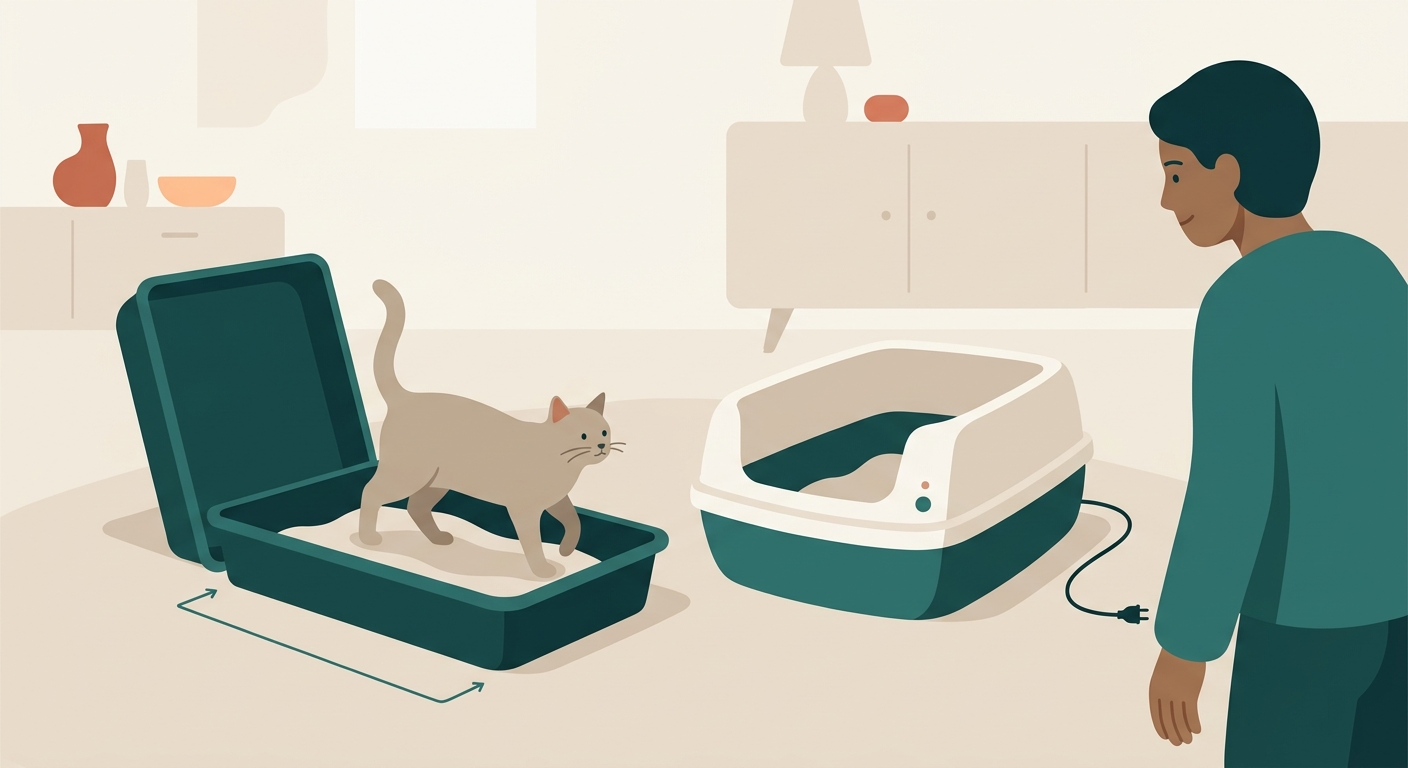
Short answer: there is no automatic litter box we can call risk-free. Start with the moving parts, not the star rating or brand name. Look for an opening a cat can still leave if a sensor misses something; then check the stated weight limits, re-entry detection, power and Wi-Fi behaviour, and whether a familiar manual tray can stay beside it. In Catpip’s July 2026 desk research, Whisker Litter-Robot 4 had the strongest positive owner-safety sentiment, with PETKIT Pura Max 2 a more cautious second. That is a research snapshot, not a guarantee for every cat or home.
If your cat has suddenly started urinating outside the box, or is straining, producing little or no urine, showing blood, vomiting, weak, or in severe pain, contact a veterinarian first. An automatic box is a convenience device, not a way to explain or manage a urinary problem.
Urgent: contact a veterinarian now
If your cat is repeatedly straining to urinate, producing little or no urine, crying out, showing blood in the urine, vomiting, becoming weak or collapsed, or seems in severe pain, contact a veterinarian or emergency clinic now. A blocked urinary tract can be life-threatening. Do not wait for a litter change, cleaner, diffuser, or home remedy to work. If you are unsure, call your local veterinary service and describe exactly what you are seeing. This wording must be checked by the publishing veterinarian for the target market.
What makes an automatic litter box safe?
Safety starts with what the mechanism does on a bad day—not with how many features fit on the product page.
Use this decision framework for any model:
- Opening geometry: Could a door, drum, rake, tray, or rotating section make a narrowing or pinch path? A design that leaves a physical way out in a fault is a better starting point than one relying entirely on software or a sensor.
- Cat detection: Does the manufacturer explain the detection methods—perhaps weight and infrared—and where the sensors are? Treat that as a manufacturer claim unless independent testing supports it.
- Re-entry detection: Does the manual explain what happens if a cat approaches or enters during a cycle? Look for a clear stop state, not just the phrase “smart sensing.”
- Fail-safe behaviour: What does the manual say happens when power, Wi-Fi, the app, or a sensor is unavailable? You want a documented state that keeps the route open and does not depend on a cloud connection for basic use.
- Cat limits: What minimum weight, kitten threshold, size limit, and entry height does the manufacturer state? A small kitten may fall outside a weight-based sensor’s stated range. Those limits should be in the current manual, not inferred from reviews.
- Manual fallback: Can automatic cycling be turned off? Can a separate, familiar tray stay available while you test the box? Your cat should not lose their only usable bathroom because an app, motor, or bin sensor has a problem.
Plain-language rule: if you cannot explain how the box stays safe after a missed detection, a power cut, a lost connection, a dirty sensor, or a curious cat returning too soon, you do not yet have enough information to buy it with confidence.
Is an open-top automatic litter box safer than a closing design?
Often, the geometry is a meaningful clue—but “open-top” is not a safety certificate. An open-top rotating tray may still move unexpectedly, have a pinch point, or fail to detect a cat. The useful question is whether the reachable openings and moving parts appear escapable throughout the cycle.
Catpip found unverified community accounts raising fatal-entrapment concerns about unrelated generic, vertically closing or rebranded boxes. Those accounts are not independently confirmed incidents, and they do not establish that a named brand or model caused an injury. They are a reason to ask more questions about any mechanically closing doorway. See the r/cats category warning and r/BuyItForLife safety discussion.
When comparing two boxes, ask:
- Can the cat back out freely at every point in the cleaning cycle?
- Is there a reachable gap that can narrow as the unit moves?
- Does the unit stop if a cat is near the opening, not only after weight is detected inside?
- Can litter, hair, or a dirty sensor cause a false “empty” or “safe to move” reading?
- Does the manual show a safe, usable state after a fault?
Do not let a camera, app, or “ten-layer safety system” replace a close look at the moving path.
Which sensors and safeguards should you check?
The useful specification is not the number of sensors. It is the behavior those sensors trigger and whether the behavior still works when the unit is dirty, offline, or partially blocked.
| Safety question | What a reassuring answer looks like | What should make you pause |
|---|---|---|
| How does it know a cat is present? | The manual explains weight, infrared, or other detection and gives a minimum cat weight. | Only a vague “smart sensor” claim, no threshold, or no manual. |
| What happens if a cat approaches mid-cycle? | The mechanism stops, leaves an escape route, and does not restart until the area is clear. | The brand describes detection but not the stop/restart sequence. |
| What if Wi-Fi or the app goes down? | Basic safe operation and a manual mode remain available offline. | The box depends on an app for stopping, unlocking, or ordinary use. |
| What if the power cuts out? | The manual documents an open, non-pinching state after a power interruption. | The outcome is undocumented, or the mechanism may pause in a closing position. |
| What if sensors get dirty? | Cleaning instructions are specific and explain the expected fault behaviour. | Linked owner reports describe false detection or continued cycles; those reports still need independent confirmation. |
| What if the cat is small or very large? | Kitten mode, minimum weight, entry dimensions, and large-cat limits are clearly stated. | A small kitten may be missed, or the entrance and interior are described only with marketing photos. |
| Can you use it manually? | The automatic cycle can be disabled and a separate tray can stay available. | The household has no practical fallback during a fault, return, or adaptation period. |
Text summary: choose the model whose safety behavior is documented under failure conditions. A clear manual, an open escape path, understandable cat-weight limits, independent owner experience, and a manual fallback matter more than an impressive feature list.
What should you test before trusting any automatic box?
Treat the first setup as a supervised trial, not a replacement of every familiar tray.
Before allowing unattended cycles, read the manufacturer’s instructions and check:
- the unit is on the specified hard, level surface and has the required clearance;
- the minimum cat weight and any kitten mode fit your cat;
- the opening and interior fit your cat without forcing a cramped posture;
- the manual explains how the unit is meant to respond to re-entry and an obstruction;
- the manual gives cleaning instructions and a fault response for dirty sensors;
- the manual documents basic behaviour when Wi-Fi is disconnected;
- the manual documents behaviour after power is removed and restored;
- you can disable automatic cycling and provide the manual tray if anything is unclear.
Catpip treats these as buying and setup questions, not a home “proof of safety” or a substitute for independent testing. Do not place a cat in a moving mechanism or deliberately create an unsafe condition. Follow the manual, supervise early use, and stop using the automatic cycle if the box behaves unexpectedly.
Which automatic litter boxes have the strongest safety evidence?
The following is a cautious overview from Catpip’s public desk research dated July 19, 2026. It is an owner-sentiment and evidence summary, not a certification, laboratory test, recall database, or promise that a model will be safe for every cat.
| Model | What the research supports | Catpip’s cautious verdict |
|---|---|---|
| Whisker Litter-Robot 4 | In the linked owner discussions, many owners describe interrupted cycles and responsive support. Other owners report sensor, maintenance, or paw-pinch concerns; Catpip has not independently verified those reports. Owner safety thread, reported paw concern, sensor discussion | Strongest positive owner-safety sentiment in this sample, with material caveats. A benchmark for comparison, not a universal guarantee. |
| PETKIT Pura Max 2 | Linked owners describe what they see as an escapable spiral design when the unit has clearance and is used above the stated kitten weight. The manufacturer’s design explanation is a manufacturer claim, not independent validation. Catpip did not find a named Pura Max 2 injury/death allegation in this limited desk research; owners also report leaks, inaccurate weights, false “pet detected” pauses, and app issues. Manufacturer design explanation, owner discussion, fault reports | Cautiously positive owner-safety sentiment. Check stated clearance, weight limits, floor requirements, and offline behaviour. Do not extend this view to Purobot. |
| Neakasa M1 / M1 Plus | Its open-top layout avoids a fully closing doorway, but that design observation is not proof of safety. Some owners report easier access for large or skittish cats. Separate community posts allege over-rotation and a cat death; these are unverified reports, and Catpip found no confirmation of causation, product revision, or regulator finding. Over-rotation PSA, unverified allegation, positive owner account | Unresolved owner safety concerns; Catpip cannot advance it on current evidence. This does not state that the brand harmed a cat as an established fact. |
| PETLIBRO Luma | Owners have posted unverified object tests in which the sensors reportedly did not stop. Catpip found no independently confirmed animal injury in those posts. PETLIBRO says Luma uses camera, motion, and weight sensors; that is a manufacturer claim, not independent validation. Owner report and manufacturer response, owner reviews | Unresolved reported concerns; Catpip cannot advance it without independent evidence. Manufacturer claims and owner tests are different kinds of evidence. |
| CATLINK Scooper Pro-X / SE / Young | Linked sources include owner praise and a Cats.com hands-on review, but Catpip found no broad, independently corroborated model-specific safety consensus. Some owners report failed rotations, errors, and support or app problems; those reports are not independent findings. Cats.com review, owner discussion | Insufficient independent data. An unverified CATLINK Open-X hand-pinch report concerns a different model and is not proof about these models. Open-X report |
| Casa Leo Leo’s Loo Too | Catpip did not find a credible injury/death report in its limited desk research, but that is not a clean safety record. The same research found too little safety-specific owner evidence for its enclosed globe and pinch-sensor design. Owners report sensor contamination and mixed reliability or support; Catpip has not independently verified those reports. Sensor report, Chewy reviews | Insufficient independent data. Lack of a found report is not approval. |
| PAWBBY Smart Litter Box | A small number of owners describe responsive sensors, which is not enough for a safety conclusion. Others report extended app outages and weak support; Catpip has not independently verified those reports. Owner discussion, app reviews, RobotWorld reviews | Insufficient independent data, with reported support concerns. “No verified injury found” is not a clean safety record. |
In plain English: the research does not identify a completely proven, risk-free automatic box. Litter-Robot 4 has the strongest positive owner safety sentiment, and Pura Max 2 is cautiously positive, but both still need correct setup, cat-fit checks, supervision, and a manual fallback.
What should you avoid when shopping?
Avoid the category shortcuts that make safety impossible to judge:
- A closing doorway with no clear escape geometry. If detection or software fails, a moving opening can become a pinch or entrapment path.
- A “CE” or compliance badge used as a complete safety argument. Compliance documentation matters, but it does not replace product-specific sensor, anti-pinch, failure-mode, and real-world testing. Importer responsibilities are outlined by the European Commission.
- A brand-level verdict applied to every model. A report about CATLINK Open-X is not proof about CATLINK Scooper Pro-X, SE, or Young. A newer camera model should not inherit the safety history of an older drum without evidence.
- No documented minimum weight or kitten rule. Small cats can be missed by weight-based detection.
- An app-dependent bathroom. Wi-Fi is useful for notifications; it should not be the only way to operate or safely stop the box.
- A first box with no manual backup. Keep a familiar, usable tray while your cat is adapting and while you are checking the unit.
- Generic or rebranded listings with no traceable support path. Changing names, unclear revisions, and no parts or warranty route work against an honest safety-first purchase.
Do not use “no reports found” as a reason to call a model safe. Catpip did not locate a regulator recall or official injury investigation for the named models in this limited desk research; that is not proof that none exists, or that a product is safe.
Is an automatic litter box a good choice for an anxious cat?
Not necessarily. Some cats may accept a predictable, quiet cleaning routine; others may avoid a noisy, moving, enclosed, or unfamiliar box. A robot does not calm a cat, treat anxiety, or explain inappropriate urination. An anxious or fearful cat may do better with an open, quiet manual setup that preserves control and a clear escape route.
If a cat’s urination changes suddenly or persistently, start with veterinary advice. Then consider the box as one environmental variable: noise, movement, entry height, visibility, access, litter texture, cleaning routine, and whether another cat can block the route. Our covered-versus-open box guide explains why there is no universal covered/open winner, and Is my cat stressed? keeps stress clues separate from diagnosis.
Pico’s log: why we keep a manual option
During Pico’s one-week reset, we noticed that he seemed readier to approach an open box. We changed more than one part of the wider routine over time—location, litter, cleaning, access—and ordinary variation was still possible. We cannot say the box shape caused the change, and we did not treat one calmer-looking day as proof.
That small, incomplete observation is why Catpip’s framework always keeps room for a manual tray. A cat needs a usable choice while a new machine is unfamiliar; the household needs one too when an app, motor, sensor, or warranty process is not working. Pico’s observations are one household’s experience, not evidence that either type of box will suit every cat.
Pico’s experience is a single household story, not veterinary advice or a guarantee for another cat.
How should you introduce an automatic litter box?
Keep the familiar tray available and make the new box an option. Place it where your cat can approach and leave without being cornered. Follow the product instructions for acclimation, cleaning, litter, minimum weight, and cycle timing.
For a low-pressure trial:
- Record the existing box type, location, litter, cleaning routine, and use.
- Add the automatic box without removing the familiar manual tray.
- Keep automatic cycling off or supervised until you understand the movement and stop behavior.
- Change one variable at a time; do not replace the box, litter, location, and routine together.
- Note observable facts: approach, entry, exit, noise, avoidance, box use, and any fault message.
- Stop the trial and contact your veterinarian if urinary signs, pain, or a sudden behavior change appear.
- Stop using the machine if it moves unexpectedly, fails to stop, creates a narrowing gap, or leaves no practical manual mode.
Read Pico’s seven-day litter-box reset for the one-variable method, and How to choose cat litter for a sensitive or anxious cat before changing substrate at the same time.
What is the safest buying decision today?
For a buyer who wants an automatic box, Catpip’s current evidence-led position is:
- Use Litter-Robot 4 as a comparison benchmark, not a guarantee. It has the strongest positive owner-safety sentiment in this research, alongside unverified reported concerns and maintenance complaints. It is listed in Estonia through Litter-Robot Estonia.
- Consider PETKIT Pura Max 2 only after cautious checks. Its owner-safety sentiment is positive enough to compare, but stated setup clearance, weight limits, offline behaviour, and linked owner reports about false detections or leaks still matter. It is listed by Euronics Estonia.
- Do not treat Neakasa M1, PETLIBRO Luma, CATLINK, Casa Leo, or PAWBBY as cleared recommendations from this research. The evidence is mixed, model-limited, too thin, or includes unresolved owner reports. Read the table rather than relying on a one-line brand reputation.
- Keep a manual tray. It is the clearest recommendation in this guide: your cat’s bathroom should not depend on one motor, app, sensor, or supply chain.
Catpip has not bought, sampled, contacted, or tested these products. No product link on this draft should be read as an endorsement or affiliate recommendation. Availability and specifications can change; check the current manual, warranty, importer, and local service terms before purchase.
Frequently asked questions
What is the safest automatic litter box?
In Catpip’s July 2026 public-research sample, Whisker Litter-Robot 4 has the strongest positive owner safety sentiment, with PETKIT Pura Max 2 cautiously positive. Neither is incident-free or guaranteed safe. Check opening geometry, re-entry stopping, cat-weight limits, power/Wi-Fi failure behavior, and manual fallback before buying.
Are automatic litter boxes safe for kittens?
Only if the specific model’s minimum weight, kitten mode, entry, and cycle rules fit the kitten and the manufacturer documents them clearly. Weight-based detection may not reliably detect a small kitten. Keep a manual tray available and follow the current model manual rather than assuming a related model has the same limits.
Are open-top automatic litter boxes safer?
Open-top geometry may reduce the risk created by a closing doorway, but it does not prove that every moving part is safe. Check for over-rotation, pinch points, re-entry detection, and a safe state after power or sensor failure. “Open-top” is a useful design clue, not a certification.
Can an automatic litter box hurt a cat?
Any moving device can create risk if its geometry, detection, or failure behavior is not adequate. Public owner reports about concerns are allegations, not automatically verified incidents. Before purchase, study the moving path and require evidence of stop behavior, escape access, cat limits, and offline/manual operation.
Should I leave a manual litter box beside an automatic one?
Yes, especially during introduction, troubleshooting, or any period when your cat’s use is uncertain. A manual tray gives your cat a usable fallback and lets you turn the machine off without removing bathroom access. Multi-cat homes may need more than one box and separate routes; see Do my cats have tension?.
Can an automatic litter box help an anxious cat?
It may suit one cat and be rejected by another, depending on noise, movement, enclosure, access, and predictability. Do not claim that a robot calms anxiety or treats inappropriate urination. For a sensitive cat, offer a quiet manual option and discuss a sudden or persistent toileting change with a veterinarian.
What should I do if the box loses Wi-Fi?
Confirm from the manual that basic use, safe stopping, and manual operation do not depend on Wi-Fi. If you cannot establish that, turn off automatic cycling and use the manual tray until you have a clear answer from the manufacturer or service provider.
Sources and editorial note
This article is based on Catpip’s internal automatic litter-box safety consensus and Estonia brand and distribution research, both dated July 19, 2026. The cited Reddit posts, retailer reviews, app reviews, and manufacturer pages are evidence of reported experiences or published claims—not independent confirmation of every event or a safety certification.
Additional sources used for the welfare boundary:
- AAHA: Why isn’t my cat using the litter box? — vet-first house-soiling guidance.
- AAFP/ISFM house-soiling guidelines — systematic assessment and overlapping contributors.
- European Commission: responsibilities of importers and distributors — compliance context, not product approval.
Not veterinary advice: This article provides general educational information and describes one household’s experience. It does not diagnose, treat, or replace advice from a licensed veterinarian. If your cat’s behavior or health changes, contact your veterinarian; seek urgent care for emergency signs. Product information is not a recommendation for every cat, and your veterinarian should advise on medicines, supplements, and medical conditions.
Next step: Keep a manual tray available, use the safety checklist before buying, and follow Pico’s seven-day reset to record one change at a time. If your cat’s urination has changed, bring the record to your veterinarian.
Editorial shortlist
Pico-Approved
The picky cat’s pick
Litter-Robot 4 — comparison benchmark
- The strongest positive owner-safety sentiment in Catpip’s limited desk-research sample.
- A documented manual fallback remains part of the comparison, rather than treating automation as essential.
- The article names reported sensor and maintenance caveats instead of smoothing them away.
Fit note: Not a risk-free choice, a product test, or a recommendation for kittens, every cat, or every home. Read the full safety checks before considering a purchase.
Checked July 19, 2026. Curation, not veterinary endorsement or a guarantee.