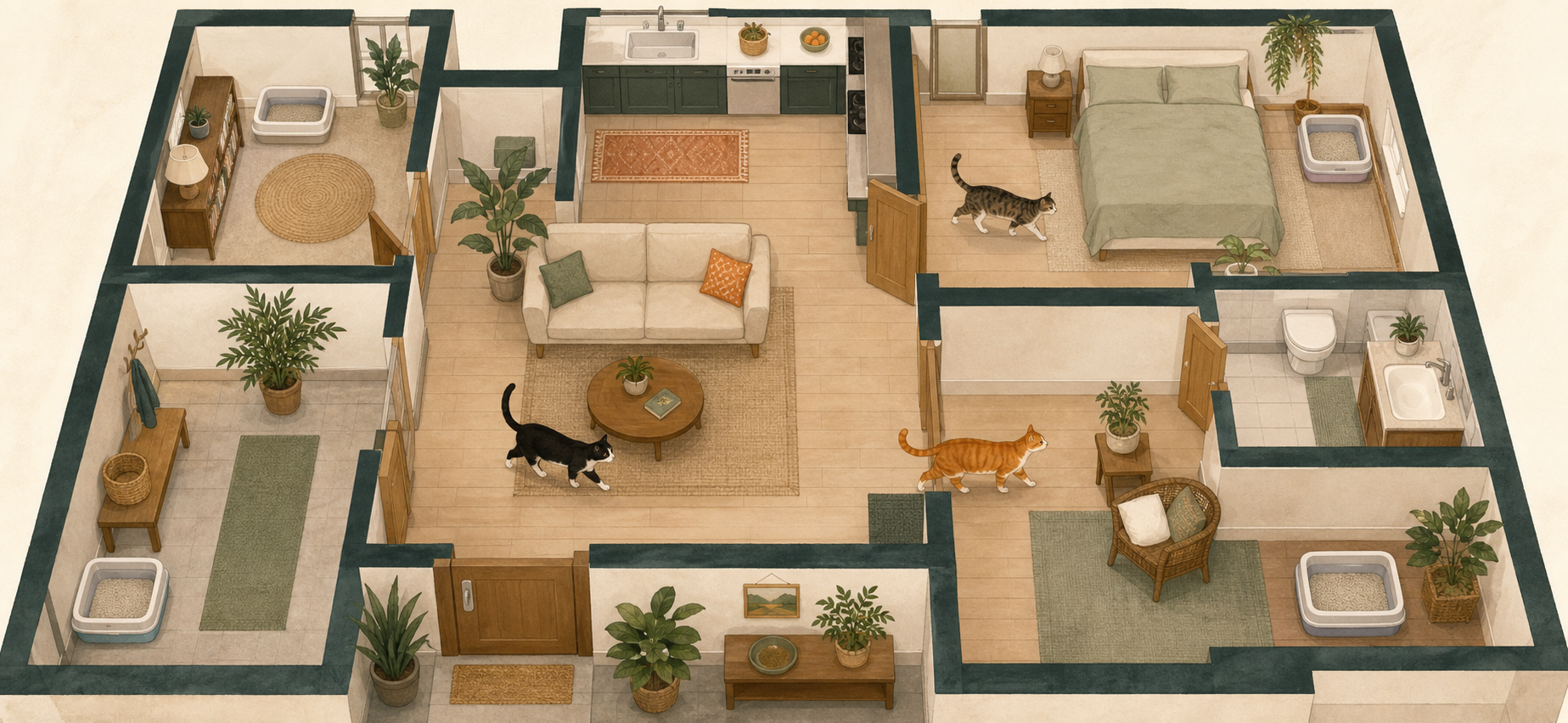
Short answer: use one box per cat plus one as a starting point: three boxes for two cats, four for three. Then look at the map, not only the total. Put boxes in separate, calm places with clear ways in and out; boxes lined up together may not feel like separate resources. A new toileting change needs veterinary advice first.
Vet first: Repeated straining, little or no urine, blood, crying, vomiting, weakness, collapse, or severe pain requires a veterinarian or emergency clinic now. A new or persistent change in box use also needs veterinary advice. Resource placement cannot explain away pain or illness. AAHA: Why won’t my cat use the litter box?
How many litter boxes should two cats have?
For two cats, start with three boxes. For three cats, start with four. It is a practical rule of thumb, not a guarantee—and it does not mean four boxes in one crowded corner have solved the access problem.
The AAFP/ISFM house-soiling guideline describes at least one more box than the number of cats as a historical rule of thumb, while emphasizing multiple locations and social relationships. The 2024 AAFP intercat-tension guideline focuses on separated resources and reduced competition. AAFP/ISFM house-soiling guideline · 2024 AAFP intercat-tension guideline
Why can three boxes still feel like one resource?
AAFP/ISFM guidance notes that cats may perceive adjacent boxes as one larger station. The same thing can happen when every box sits in one room, hallway, or closet: one cat can watch the only approach. A quieter cat may technically have a box available yet still avoid it when another cat can block the entrance or exit.
| Setup question | More useful arrangement | Risk to look for |
|---|---|---|
| Number | Start with cats + 1, then adjust to actual use and social groups | Treating the rule as a guarantee |
| Separation | Different rooms or separated zones where practical | All boxes lined up side by side |
| Approach | Calm route with enough room to enter, turn, and leave | Narrow hallway, dead end, or single doorway |
| Visibility | A cat can use the box without being watched or cornered | Another cat sitting near the entrance |
| Levels | At least one usable option on each home level where practical | All boxes on one floor while a cat avoids stairs |
| Cleaning | Regular scooping and a stable routine | A box is technically present but unpleasant or overlooked |
Text summary: count boxes, then audit distribution. A separate location, clear route, and ability to leave matter as much as the total number. One controlled station can remain one social resource even when several boxes are inside it.
Where should you put litter boxes in a multi-cat home?
Choose locations that are quiet without feeling trapped. Keep boxes away from food and water, loud appliances, busy doorways, and places where a person or cat can control the only route. In a multilevel home, put options on levels the cats really use. A box behind a door that is usually closed is not an available resource.
Walk the route from each cat’s resting place to each box. Can the cat approach without passing the other cat? Can it turn around and leave without being followed into a corner? Are there two practical directions out, or at least a route that cannot be easily guarded? The AAFP guideline recommends distributing litter boxes and scratching surfaces across locations; it also notes that adjacent boxes may be perceived as one. AAFP guideline
How can you spot litter-box blocking?
Look for a repeated sequence instead of waiting for a fight: one cat stares from a doorway, settles by an entrance, follows the other toward the box, or makes the other cat turn around and wait. Record the time, place, cat, route, and what happened next. Those notes are clues to take to a veterinarian, not a diagnosis to make at home.
If tension is active, do not pick up cats during a confrontation or force them to share a room. Use a solid visual barrier if needed and separate safely. Make sure every cat has access to a box, food, water, and a resting area during any short-term separation plan; ask your veterinarian for individualized guidance. AAFP intercat-tension guideline
What is a practical placement audit for two or three cats?
Draw a rough floor plan and mark sleeping, eating, resting, window, stair, and litter locations. Then mark bottlenecks: doorways, narrow corridors, appliance corners, and places where one cat waits. Give each box a letter and record which cat uses it when you can observe without disturbing them.
| Box | Room/level | Approach and exit | Nearby pressure | Use or avoidance observed |
|---|---|---|---|---|
| A | ||||
| B | ||||
| C | ||||
| D, if needed |
Text summary: the audit connects the number of boxes to actual movement through the home. It can reveal that a box is inaccessible, socially exposed, or simply unused, but it cannot diagnose the reason for a toileting change.
What did Pico’s home map teach us?
Pico’s log: the doorway mattered more than the count
In Pico’s household, we counted boxes before we drew the approach routes. Once we mapped them, one doorway looked less neutral: it made a path more predictable and exposed than we had realized. We do not claim the doorway caused any behavior, and we do not know how Pico would respond in another layout. For us, the useful next step was mapping access before buying or moving more equipment.
Pico’s experience is a single household story, not veterinary advice or a guarantee for another cat.
When should you call the vet instead of moving boxes?
Call promptly for a new or persistent change in litter-box use, appetite, drinking, mobility, grooming, or behavior. Use urgent care for the signs in the box above. A cat that avoids one box may have a social or location problem, but it may also be uncomfortable; moving boxes should not delay an examination.
Once veterinary guidance is in place, make one layout change at a time when possible. Keep a familiar option available, clean consistently, and share your route map. Do not punish accidents or chase a cat toward a box.
For the wider plan, read the multi-cat tension pillar, the cat-first litter-box setup pillar, and the cat-litter pillar. For a possible urine accident, use the vet-first cat-peeing-everywhere guide and the spraying-versus-peeing observation guide.
CTA: Sketch the routes today, label each current box, and bring the map—not a self-diagnosis—to your veterinarian.
FAQ
How many litter boxes do two cats need?
Three is a useful starting point under the one-per-cat-plus-one rule. Spread them through separate locations and check whether both cats can approach and leave without being watched or blocked.
How many litter boxes do three cats need?
Four is a useful starting point. The right plan also depends on levels, rooms, social groups, mobility, health, and actual access. More boxes in one row may still function as one station.
Can litter boxes be next to each other?
They can be physically adjacent, but AAFP/ISFM guidance notes that cats may perceive adjacent boxes as one large box. For multi-cat tension, separated locations are usually a more informative starting arrangement.
Should litter boxes be in separate rooms?
Separate rooms can help when they are calm, accessible, and not dead ends, but a room alone is not a guarantee. Evaluate approach, exit, traffic, other cats, doors, and the cat’s actual use.
What if one cat guards the litter box?
Record the route and safely reduce contact rather than punishing or forcing a meeting. Add separated resources where practical and contact your veterinarian, especially if any cat has a new toileting or health change. An intercat-tension professional can help with a fuller plan.
Sources and editorial note
- 2024 AAFP Intercat Tension Guidelines — separated resources, visual barriers, routes, and transition-room planning.
- AAFP/ISFM Guidelines for Diagnosing and Solving House-Soiling Behavior in Cats — box number, location, adjacency, access, and cleaning guidance.
- AAHA: Why Won’t My Cat Use the Litter Box? — veterinary-first boundary.
Not veterinary advice: This article provides general educational information and describes one household’s experience. It does not diagnose, treat, or replace advice from a licensed veterinarian. If your cat’s behaviour or health changes, contact your veterinarian; seek urgent care for emergency signs. Product information is not a recommendation for every cat, and your veterinarian should advise on medicines, supplements, and medical conditions. Pico’s experience is not evidence that the same approach will work for another cat.