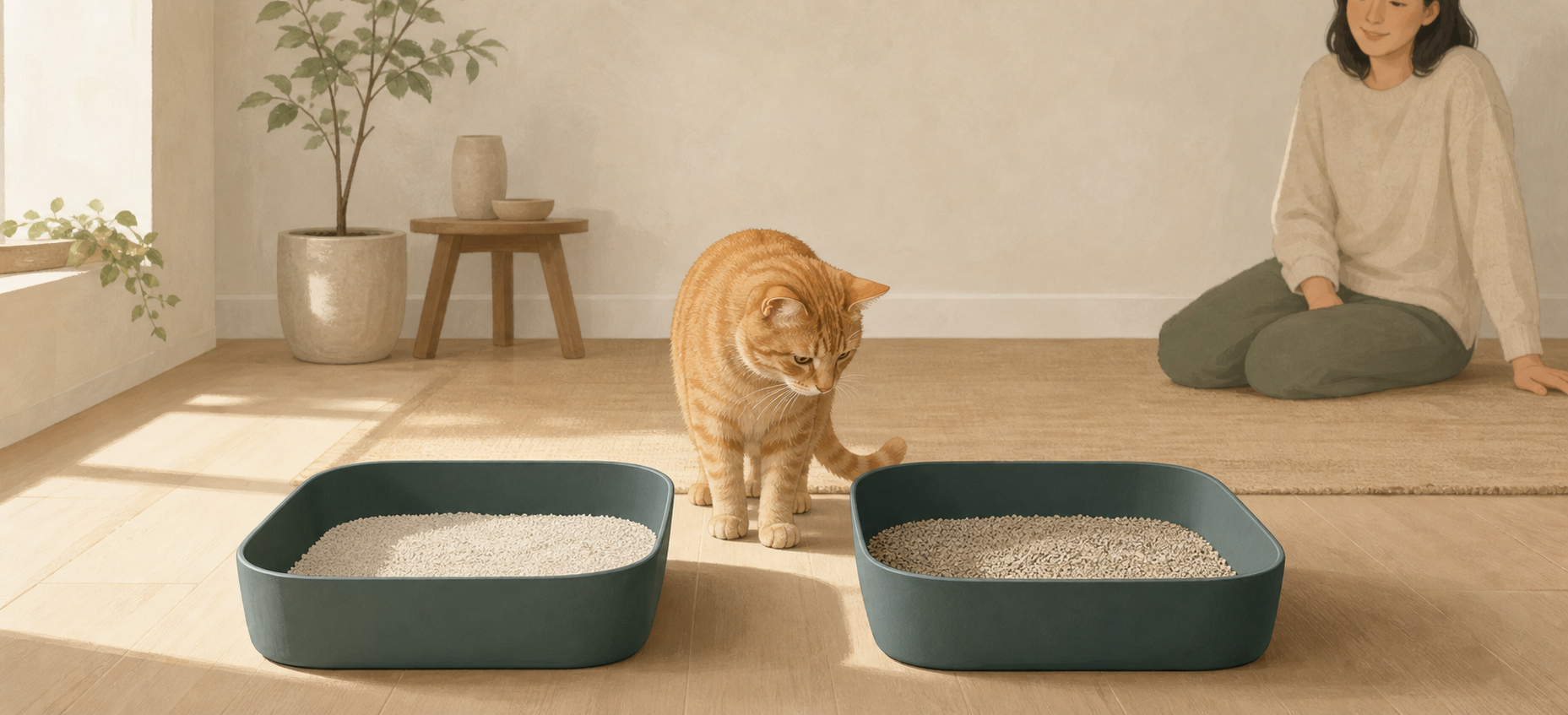
Short answer: leave the familiar litter available, then offer the new litter in a separate box or make one small, recorded change at a time. Scoop both boxes the same way and watch what your cat actually does; a refusal is information, not stubbornness. If box use suddenly changes or your cat seems uncomfortable, contact a veterinarian before you continue the switch.
Vet first: Repeated straining, little or no urine, blood, crying, vomiting, weakness, collapse, or severe pain means contact a veterinarian or emergency clinic now. A sudden or persistent box change also warrants veterinary advice. Do not use a litter transition to explain away possible pain. AAHA: Why won’t my cat use the litter box?
Why should a litter change be gradual?
Changing litter can alter smell, texture, dust, tracking, depth, and the feel under your cat’s paws. Your cat may accept the new substrate, avoid it, or happen to change box use for an entirely different reason. Going gradually keeps the story readable: if use changes, you know what changed and can return to the last option your cat used comfortably.
AAHA/AAFP guidance describes plain, unscented, clumping litter as a common preference for adult cats while emphasizing individual variation. The AAFP/ISFM house-soiling guideline also says cats can have different substrate preferences and recommends offering choices rather than imposing a universal answer. AAHA/AAFP environmental guidance · AAFP/ISFM guideline
What is the safest first step when introducing new litter?
If your cat is using the current box normally, place a clean second box with the new litter where your cat can reach it without passing a noisy appliance, closed door, or another pet. Leave the familiar box exactly as it is. That gives your cat a real choice while keeping the known option intact.
If you only have one box, change a small amount of litter after a stable baseline and keep notes. Do not also move the box, change its size, add fragrance, switch cleaners, or alter the cleaning schedule on the same day.
How do you change litter gradually?
There is no evidence-based percentage or timetable that suits every cat. Use this as a cautious framework, slow down when your cat avoids the new option, and return to the last accepted step when needed. For a cat with medical, mobility, or toileting concerns, ask your veterinarian to help shape the plan.
| Stage | What to do | What to record | Move forward when |
|---|---|---|---|
| Baseline | Keep the familiar litter and box stable for several days if possible | Box use, scooping, location, household changes | Use is ordinary for your cat and no health concern is present |
| Choice | Offer familiar and new litter in separate, equivalent boxes | Which box is approached and used; hesitation; access issues | Your cat uses the new option without a concerning change |
| Small mix | If separate choice is not practical, add a small amount of new litter while preserving most of the familiar substrate | Approximate ratio, depth, use, and any avoidance | The current step is accepted consistently |
| Slow increase | Increase the new litter in small steps, pausing at any uncertain response | The exact change and what stayed the same | The cat continues using the box comfortably |
| Decision | Keep the accepted litter or return to the familiar option | What the trial can and cannot show | You have a repeatable observation, not a single visit |
Text summary: preserve a familiar option, introduce one new variable, pause at each accepted step, and record the exact change. A slower transition is more informative than a fast switch followed by guesswork.
What should you do if your cat refuses the new litter?
Make the familiar litter available straight away, keep the box clean, and contact your veterinarian if the refusal is sudden, persistent, or comes with any physical or toileting change. Do not punish, carry your cat into the box, or remove every alternative to force a decision. A box should stay a safe, predictable resource.
Check whether the “new litter” also changed the box, location, depth, liner, cleaner, or surrounding traffic. If more than one variable changed, the result does not identify litter as the cause. A cat that stands on the edge, hesitates at the entrance, or chooses another surface is giving you an observation to record—not a diagnosis.
How should you compare litter types without marketing taking over?
| Feature | Question for a fair trial | Cautious comparison |
|---|---|---|
| Scent | Did the scent change at the same time as use? | Plain, unscented is a reasonable starting point; individual response varies. |
| Texture | Does the paw feel differ from the familiar substrate? | Keep texture stable unless texture is the variable being tested. |
| Clumping | Can you scoop without changing depth or smell? | Many adult cats prefer clumping litter, but it is not universal. |
| Dust/tracking | What does the label say, and what do you observe? | Compare label details and household observations, not “low dust” as a guarantee. |
| Depth | Is there more or less material to dig in? | Keep depth consistent during a texture trial. |
Text summary: choose one test question—scent, texture, clumping, dust, or depth—and hold the others steady. “Natural,” “odor control,” and “sensitive” are product language, not a prediction of your cat’s preference.
What did Pico’s litter-switch diary show?
Pico’s log: the variable we did not control
In Pico’s household, we changed litter while also keeping an eye on the box location. That was too much at once. We saw a different response, but could not honestly say whether texture, room traffic, or timing mattered most. We do not know which variable carried the weight. What we kept from the trial was simple: restore the familiar option, write down the baseline, and make the next change smaller.
Pico’s experience is a single household story, not veterinary advice or a guarantee for another cat.
What should you do today?
- Check for urgent signs and contact the vet for a sudden or persistent toileting change.
- Keep the current litter, box, location, depth, and cleaning routine documented.
- Add a separate new-litter option if possible; do not remove the familiar box.
- Record use for each box and stop if your cat avoids the box or seems uncomfortable.
- Share the log with your veterinarian before making a bigger change.
For the wider plan, read the cat-litter pillar, our sensitive-cat litter choice guide, and the cat-first litter-box setup pillar. If another cat may be controlling access, use the multi-cat tension resource plan.
CTA: Copy the table into a note, record one transition step, and bring it to your veterinary appointment if use changes.
FAQ
How long does it take to switch cat litter?
There is no universal schedule. Some cats accept a new option quickly and others need a slower, choice-based transition. Keep the familiar option available and move forward only when use remains comfortable; ask your veterinarian about your cat’s situation.
Can I mix old and new cat litter?
You can use a small, documented mix as one transition method if your cat is otherwise well and still has access to an accepted option. Increase gradually, change no other variable, and return to the last accepted step if use becomes uncertain.
What if my cat will not use the new litter?
Restore or retain the familiar litter, avoid forcing the change, and check with your veterinarian for a sudden or persistent refusal. The reason may be the substrate, the box, access, discomfort, or another household factor.
Is unscented cat litter better?
Plain, unscented litter is a guideline-backed starting point for many adult cats, but individual preference varies. Test it gradually and do not present it as a universal answer.
Should I change litter if my cat is peeing outside the box?
Do not make litter the first explanation. Contact your veterinarian about a new or persistent change, and use the urgent-care signs above. A litter trial may be appropriate later as one controlled setup question.
Sources and editorial note
- AAHA/AAFP Feline Life Stage Guidelines: Behavior and Environmental Needs — common preferences and individual variation.
- AAFP/ISFM Guidelines for Diagnosing and Solving House-Soiling Behavior in Cats — substrate choice, box management, and systematic work-up.
- AAFP/ISFM Feline Environmental Needs Guidelines — minimizing disruptive sensory changes.
Not veterinary advice: This article provides general educational information and describes one household’s experience. It does not diagnose, treat, or replace advice from a licensed veterinarian. If your cat’s behaviour or health changes, contact your veterinarian; seek urgent care for emergency signs. Product information is not a recommendation for every cat, and your veterinarian should advise on medicines, supplements, and medical conditions. Pico’s experience is not evidence that the same approach will work for another cat.