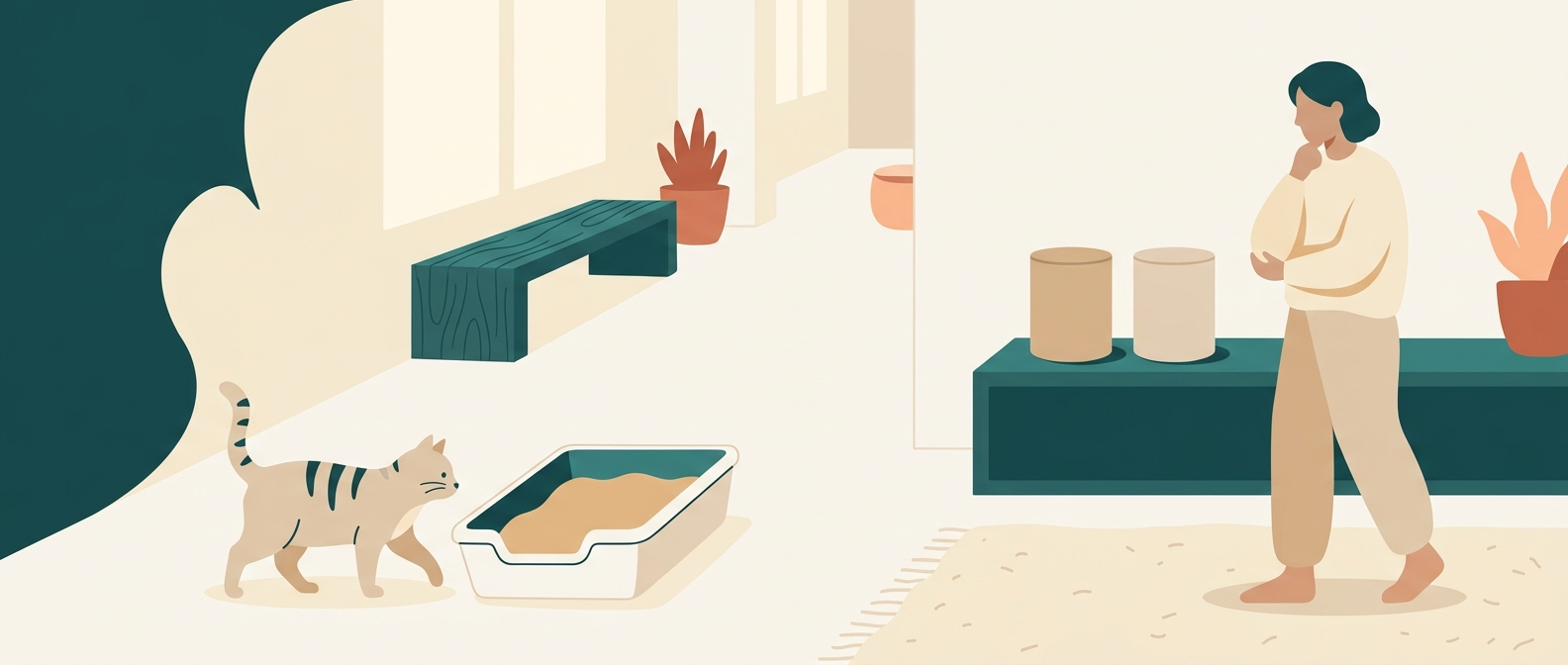
For a sensitive or anxious cat, start with a litter that is plain, unscented, and easy to keep clean—often a clumping litter for adult cats—then protect the familiar setup and change only one variable at a time. Preference is individual, and a sudden refusal to use the box needs veterinary advice before a litter experiment. Litter can be part of the picture, not a diagnosis or a promise.
Catpip began with Pico’s long house-soiling journey, so we know how tempting it is to replace everything at once. A calmer approach is usually more useful: check health and access first, keep a record, and give your cat a real choice rather than forcing a fast switch.
Vet first: do not make litter the whole explanation
Contact your veterinarian promptly if your cat has suddenly stopped using the box or the change persists. Contact a veterinarian or emergency clinic now for repeated straining, little or no urine, crying out, blood in urine, vomiting, weakness, collapse, or severe pain. Do not wait for a new litter to work. AAHA advises a veterinary examination as the first step for house-soiling. AAHA: Why isn’t my cat using the litter box?
What is a sensible first litter choice for a sensitive cat?
If you need a starting point after veterinary guidance, choose a plain, unscented, clumping litter that your cat can reach in a clean, familiar box. The AAHA/AAFP life-stage guidance says most adult cats prefer clumping litter and most cats prefer plain, unscented litter, while also stressing that individual preferences vary. A starting point is not a universal winner. AAHA/AAFP guidance
Do not confuse “sensitive” or “anxious” with a litter diagnosis. Pain, mobility changes, box access, cleanliness, household change, and conflict can overlap with substrate preference. For the wider safety route, start with My cat is peeing everywhere: a vet-first decision tree.
How do scent, clumping, texture, dust, and tracking compare?
The table is a set of questions to test, not a product ranking. “Low dust,” “natural,” and “odor control” are marketing terms unless a current label explains exactly what it means.
| Feature to compare | A cat-first question | A cautious starting point | What it cannot tell you |
|---|---|---|---|
| Scent | Has the litter or cleaner become perfumed, or does your cat avoid the box after that change? | Plain, unscented litter is a reasonable first option; some cats may find scented litter aversive. | Whether scent is the only reason for a toileting change |
| Clumping | Can you remove waste promptly without replacing the whole tray? | Many adult cats prefer clumping litter when it is kept clean. | Whether a clumping product suits every cat or medical situation |
| Texture/substrate | Does your cat have a known familiar texture, or did refusal start after pellets, crystals, or another substrate? | Preserve the familiar texture where possible; offer a matched alternative only in a controlled trial. | The cause of pain, fear, or box avoidance |
| Dust and tracking | What does the label say, and what do you actually observe around the box and on paws? | Compare label directions, ingredient/material information, and your own observations rather than assuming a claim equals comfort. | A health or respiratory assessment |
| Odor control | Is the product adding fragrance for people rather than improving the cat’s experience? | Prioritize scooping and a stable, unscented setup over a stronger perfume. | Whether a smell is causing an accident |
Plain-text summary: plain, unscented, clumping litter is a guideline-backed starting point for many adult cats. Keep the familiar texture and box setup stable where you can, and compare dust, tracking, and odor claims against the label and your cat’s observed use—not against a promise on the bag.
What does the substrate study actually show?
One small field study compared clay granules, silica microgranules, and wood pellets in 18 indoor cats during its first phase. In that study, the cats significantly preferred clay or silica substrates over wood pellets; a second phase compared clay and silica in 12 cats and found more defecation in clay. The study does not prove that clay is best for every cat, does not settle dust or health questions, and did not test every litter type or every household. Villeneuve-Beugnet & Beugnet, Field assessment of cats’ litter box substrate preferences (2018)
Use the study as a reason to offer choice carefully, not as a reason to abruptly remove a litter your cat is already using comfortably. A cat who has a medical problem or a blocked route to the box needs a different next step.
How can you switch litter without creating a disruptive change?
Only try a litter transition after urgent concerns have been ruled out and a veterinarian has advised on a new or ongoing elimination change. The lowest-drama option is usually an additional, similar box with the trial litter—not an overnight replacement of every box.
- Write a baseline first. For several ordinary days, note box use if observed, box location, cleaning, litter type, and any recent home changes. “Not observed” is useful data.
- Keep the rest stable. Do not move the box, change the cleaner, buy a new covered box, and switch litter in the same week.
- Offer one comparable option. Keep the familiar litter available. Use a similar box in a similarly accessible, quiet location where your home allows.
- Change one feature. For example, trial unscented rather than scented, or a different texture—not scent, texture, depth, and box style together.
- Record choice and warning signs. Note which box was used, any hesitation, route blocking, accidents, and any illness signs. Do not watch or film a cat in a way that adds pressure.
- Stop and call the veterinarian if use worsens. A trial is not a reason to continue through pain, straining, little/no urine, blood, or a sudden refusal.
For a printable structure, use Pico’s seven-day litter-box reset. If you are also considering a lid change, read Covered vs open litter boxes: evidence plus a fair home trial rather than changing the box and litter together.
When might litter not be the main problem?
Litter is only one part of a usable bathroom. AAHA lists substrate, box hygiene, style, size, location, illness, stress in the home, and conflict between cats as possible contributors to discontinued box use. AAHA/AAFP guidance
Before spending on another bag, check these observable basics:
- Can your cat reach a box without a dog, noisy appliance, closed door, or another cat in the way?
- Is there a quiet approach and a route away from the box?
- Has the box become harder to enter or too small for comfortable turning?
- Has cleaning changed, including a strongly scented cleaner?
- Did a move, visitor, renovation, new pet, or outdoor-cat activity start around the same time?
If the deposits are outside the box, record posture, surface, amount, timing, and recent changes; do not label the pattern at home. Is it spraying or peeing? The photo-free clues to record for your vet explains how. For bedding accidents, see Cat peeing on the bed: the first 24 hours and mistakes to avoid.
If you are considering a pheromone product alongside a veterinarian-led home plan, keep it separate from a litter switch and use Cat pheromone diffusers: what they can support and what they cannot replace for realistic, label-led questions.
Pico’s log: why we do not name a “best” litter from one household
Pico’s documented reset involved litter-box setup, litter, pheromone context, and routine over time. We learned to change one variable, record what happened, and avoid making a single bag of litter the explanation. Our record does not support a complete litter-by-litter timeline or a universal “winner,” so we will not invent one.
The useful part of our experience was the order: safety first, then a stable setup and a calm record. The clearer one-variable lesson is in Pico’s seven-day litter-box reset.
Pico’s experience is a single household story, not veterinary advice or a guarantee for another cat.
What should you do next?
If your cat is suddenly avoiding the box, contact your veterinarian. If health concerns have been addressed, keep a familiar, accessible setup available and trial one litter feature at a time. The goal is not to find a fashionable “anxiety litter”; it is to make a calm, evidence-informed choice that gives your veterinarian useful observations if the problem continues.
Frequently asked questions
Is unscented litter better for anxious cats?
Plain, unscented litter is a reasonable starting point because AAHA/AAFP guidance says most cats prefer it and some cats may find scented litter aversive. It is not a diagnosis or a guarantee; individual preference and the rest of the box setup matter. A sudden or persistent change in box use needs veterinary advice.
Is clumping litter better than non-clumping litter?
Most adult cats prefer clumping litter according to AAHA/AAFP guidance, but this does not make it right for every individual cat. Compare the cat’s observed use, the current label, cleaning practicality, and veterinary advice rather than forcing a switch.
My cat will not use new litter. Should I mix it into the old litter?
Do not make a sudden all-box replacement. After veterinary guidance, preserve a familiar, usable option and change only one variable at a time. An additional comparable box can give you a clearer observation than mixing several new changes together.
Are wood pellets bad for cats?
No single material is automatically wrong for every cat. In one small study, the studied cats preferred clay or silica over wood pellets, but that result does not decide what every cat will accept or why a cat is avoiding the box. Individual preference, access, health, and the wider setup still matter.
What does “low dust” cat litter mean?
It is usually a product claim, not a standardized promise of comfort or health. Read the current label, compare the material and directions, and note what you observe. Discuss coughing, breathing changes, or any health concern with your veterinarian instead of relying on a litter claim.
Sources and publication note
- AAHA/AAFP Feline Life Stage Guidelines: behavior and environmental needs — litter preference, setup contributors, and no-punishment guidance.
- AAHA: Why isn’t my cat using the litter box? — vet-first and urgent-care boundary.
- Villeneuve-Beugnet V, Beugnet F. Field assessment of cats’ litter box substrate preferences. Journal of Veterinary Behavior (2018) — small substrate-preference study and its limits.
Not veterinary advice: This article provides general educational information and describes one household’s experience. It does not diagnose, treat, or replace advice from a licensed veterinarian. If your cat’s behaviour or health changes, contact your veterinarian; seek urgent care for emergency signs. Product information is not a recommendation for every cat, and your veterinarian should advise on medicines, supplements, and medical conditions. Pico’s experience is not evidence that the same approach will work for another cat.
Next step: Follow Pico’s one-variable reset, keep the familiar option available, and bring your observations to your cat’s veterinary appointment.